Office for Risk Management of International Collaborative Research
Background and Objectives
Today’s research activities are evolving at an unprecedented pace and on an unprecedented scale, driven by the promotion of international collaboration and open science. This is an essential trend for generating new knowledge and addressing social challenges.
At the same time, the internationalization and openness of research have given rise to a diverse and complex array of risks, such as unintended technology leakage, conflicts of interest, and conflicts of commitment.
In light of these circumstances, the University of Osaka established the “Office for Risk Management of International Collaborative Research” in October 2025 through the evolutionary reorganization of the “Research Integrity Management Office.” This initiative aims to foster an environment where researchers can engage in international collaboration and challenging research without the burden of unforeseen risks.
This office plays a central role in university-wide risk management, balancing a proactive stance to vigorously promote open science with a defensive stance to protect the research integrity and research achievements from threats.
Roles of the Office
Under the direction of the Executive Vice President in charge of research, the office conducts activities based on the following two pillars:
1.Research on research risks themselves
2.Implementation of university-wide risk management based on research achievements
This continuous cycle between research and practice is the Office’s defining characteristic. Rather than relying solely on regulations, we aim to scientifically analyze and study the structure of risks and, based on these insights, provide researchers with highly effective, concrete support measures.
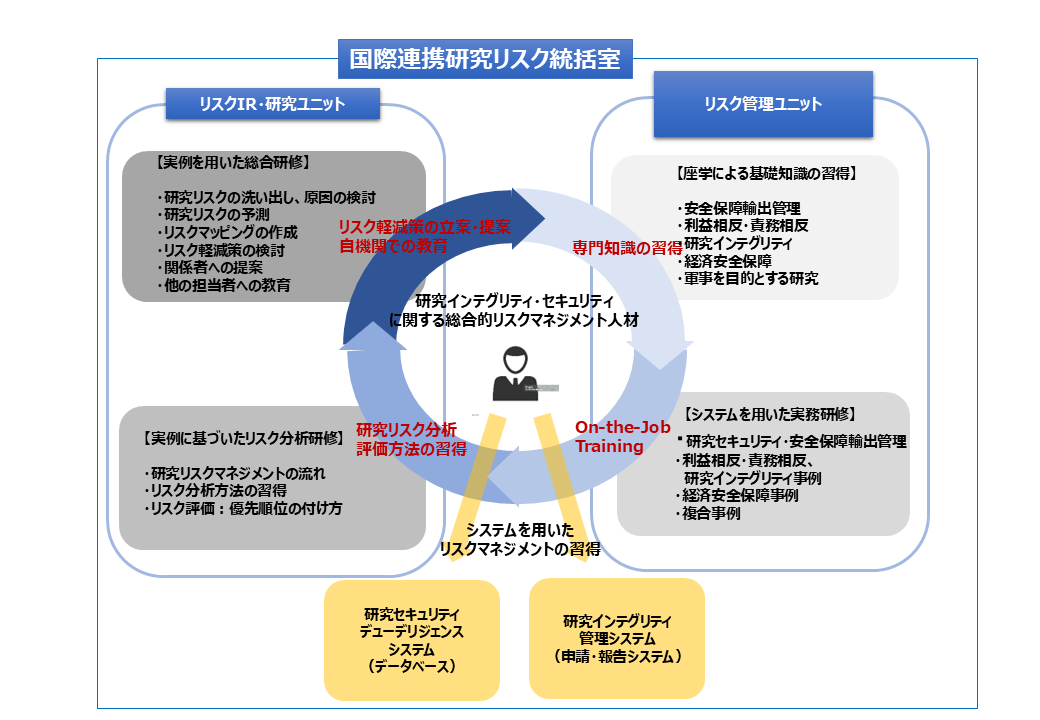
To this end, we have established two units: the "Risk IR/Research Unit" and the "Risk Management Unit," integrating data-driven strategic risk analysis and research functions with research-based risk management functions.
Main Initiatives
To effectively address increasingly complex research risks, the office promotes the following initiatives in an interdisciplinary manner while collaborating closely with experts and relevant departments within the university.
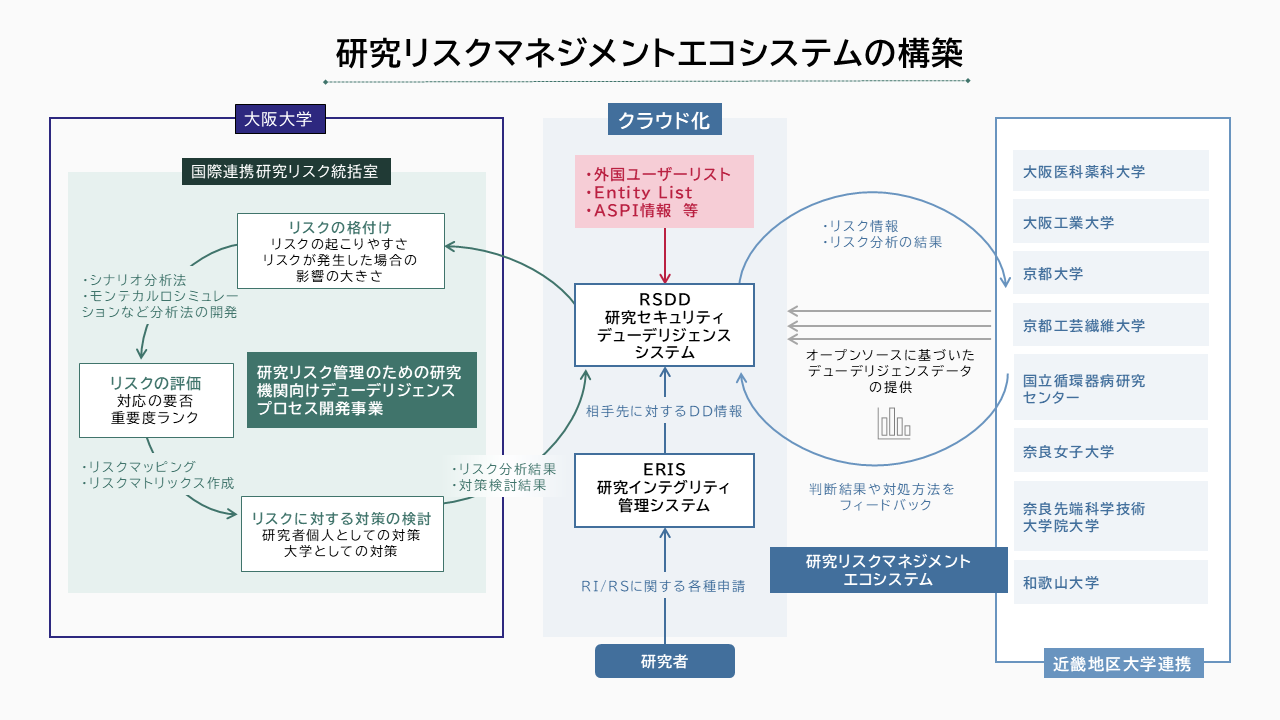
Project 1: Development of Institutional Due Diligence Processes for Research Risk Management
Risks associated with international collaboration and research activities have traditionally been discussed based on individual experience and intuition, making it difficult to objectively grasp the overall picture.
This project implements initiatives that serve as the foundation for all risk management by unraveling these complex research risks through a scientific approach.
Specifically, we will first gain a deep understanding of the characteristics of various research fields, such as humanities and social sciences, science and engineering, and life sciences, to identify the unique risk factors inherent in each activity. Next, we will analyze how these risk factors influence one another, using methods such as “risk mapping” to analyze causal relationships and visualize the complex structure of risks.
The aim of this initiative is to accurately and objectively grasp the overall picture of risks.
This will establish a solid foundation for achieving truly effective and rational risk management by preventing both oversights and excessive risk-control measures without unnecessarily increasing the burden on individual researchers and administrative staff.
Project 2: Development of a Risk Management Model Using Research Security and Integrity Tools
“Due diligence”—the process of investigating the risks of counterparties—is essential for promoting international collaboration. However, many universities face challenges such as a shortage of specialized personnel and the high cost of existing external services. This disparity in risk management capabilities presents a major obstacle to Japan’s overall research capacity.
Therefore, through this Cabinet Office-funded project, collaborating universities developed an affordable and practical risk management tool.
The key feature of this initiative is that it goes beyond simply providing data; it involves compiling and sharing the “practical insights” from each university into a database. This enables even inexperienced staff to make accurate judgments, and we aim to build a sustainable ecosystem where insights are accumulated and developed across all participating institutions.
Project 3: Establishment and Operation of the "Consortium for Research Integrity & Security Ecosystem (RISE)"
There are limits to what individual universities can do on their own to address increasingly sophisticated and diverse research risks. To implement truly effective countermeasures, a collaborative, “collective” approach is essential—one that transcends organizational boundaries to share insights and best practices and jointly confront these threats.
Therefore, the University of Osaka leads the establishment and operation of the “Consortium for Research Integrity & Security Ecosystem (RISE)” as a new collaborative framework to bring together the expertise of universities and research institutions in Japan. This initiative aims for the sound development of the entire Japanese academic community through mutual learning and support among participating institutions.
The consortium’s main activities are wide-ranging, including: [utilization of the RSDD system], [joint development of training programs for practitioners], [formulation of effective countermeasures (best practices)], and [policy recommendations to the government]. Through these activities, which individual universities alone cannot achieve, we will enhance the international credibility of the entire Japanese academic community and build an environment for the future where researchers can pursue their research with peace of mind.
Click here for the Consortium for Research Integrity & Security Ecosystem (RISE)
Project 4: Training Specialized Personnel for Research Risk Management (Project for Establishing a System for Research and Development Management Personnel)
Even the finest tools and systems can only demonstrate their true value when there are “personnel” capable of utilizing them effectively and making appropriate judgments. Training personnel to take on this new specialized field is an urgent priority for universities throughout Japan.
Therefore, we have developed the “Research Risk Management Specialist Training Program,” which condenses the knowledge and expertise of the University of Osaka. This program offers courses tailored to the experience level of participants, ranging from "Foundation Course" for those new to the field to "Intermediate Course" for those aiming to acquire comprehensive analytical skills.
A key feature of the training is its practical, “interactive learning” approach, which goes beyond mere knowledge acquisition. Through training using actual case studies and forums where participants discuss challenges from their own organizations, participants will learn to cultivate the essential skills needed to solve problems they face in the field. This strongly supports the development of experts capable of leading risk management efforts within their respective organizations.