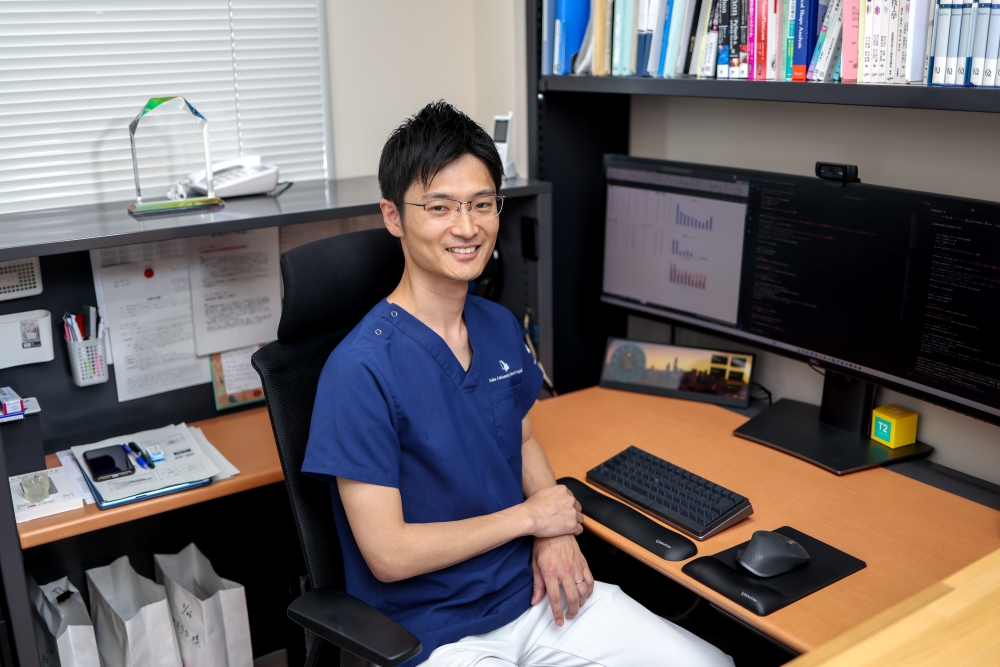
Dr. Tomoaki Mameno, Associate Professor (Lecturer), The University of Osaka Dental Hospital
Big data reveals a hidden periodontal health gap when symptoms fall silent
“A small change inside the mouth can make a big difference to quality of life,” says Dr. Tomoaki Mameno. That conviction links the three parts of his work—treating patients, training future dentists, and studying oral health at population scale. In his latest study [1], he and his colleagues analyzed dental-checkup data from nearly 160,000 adults aged 75 and older . They found a striking gap between what people noticed in their mouths and what dental professionals found, particularly among older adults with dementia.
A hidden gap between what people feel and what dentists find
With little pain to announce its presence, periodontal disease can progress unnoticed. Bleeding gums or loose teeth may be among the few signs that prompt someone to seek care, yet even these can be easy to miss. The team compared responses to brief oral-health questions with findings recorded during public dental checkups in Osaka Prefecture. Among participants whose gums bled during examination, roughly three in four did not report bleeding themselves. Recognition of tooth mobility was also limited and was even lower among people with dementia.
“Periodontal disease has long been called a ‘silent disease,’ but our analysis of data from 160,000 people showed just how difficult it can be for older adults—especially those with dementia—to notice it,” Dr. Mameno says. “I hope these findings will help more people understand the importance of regular dental examinations.”
The point is not that questions about symptoms have no value. They are quick and can open a conversation. But they are not a substitute for looking inside the mouth. The study found that self-reported bleeding had poor diagnostic accuracy; reports of loose teeth performed somewhat better but still missed many cases. For people whose cognitive function is declining, relying on self-awareness alone may leave clinically important changes undetected. Regular examinations and cooperation among dental, medical, and care professionals therefore become especially important.
Nearly 160,000 dental checkups speak
The research used checkups conducted from April 2018 to March 2020 through the Oral Health Screening to Assess Keys of Well-Aging (OHSAKA) study. Questionnaire responses and clinical findings were linked with health-insurance records, making it possible to test a simple but unresolved question at an unusually large scale. How accurately do people in later life recognize their own periodontal condition?
The scale strengthens the finding, but the researchers also set clear boundaries. Dementia was identified through prescriptions for anti-dementia medication rather than direct cognitive testing. People with severe dementia or those living in care facilities may have been less likely to attend checkups. And because the study was cross-sectional, it can show an awareness gap but cannot establish why the gap occurs.
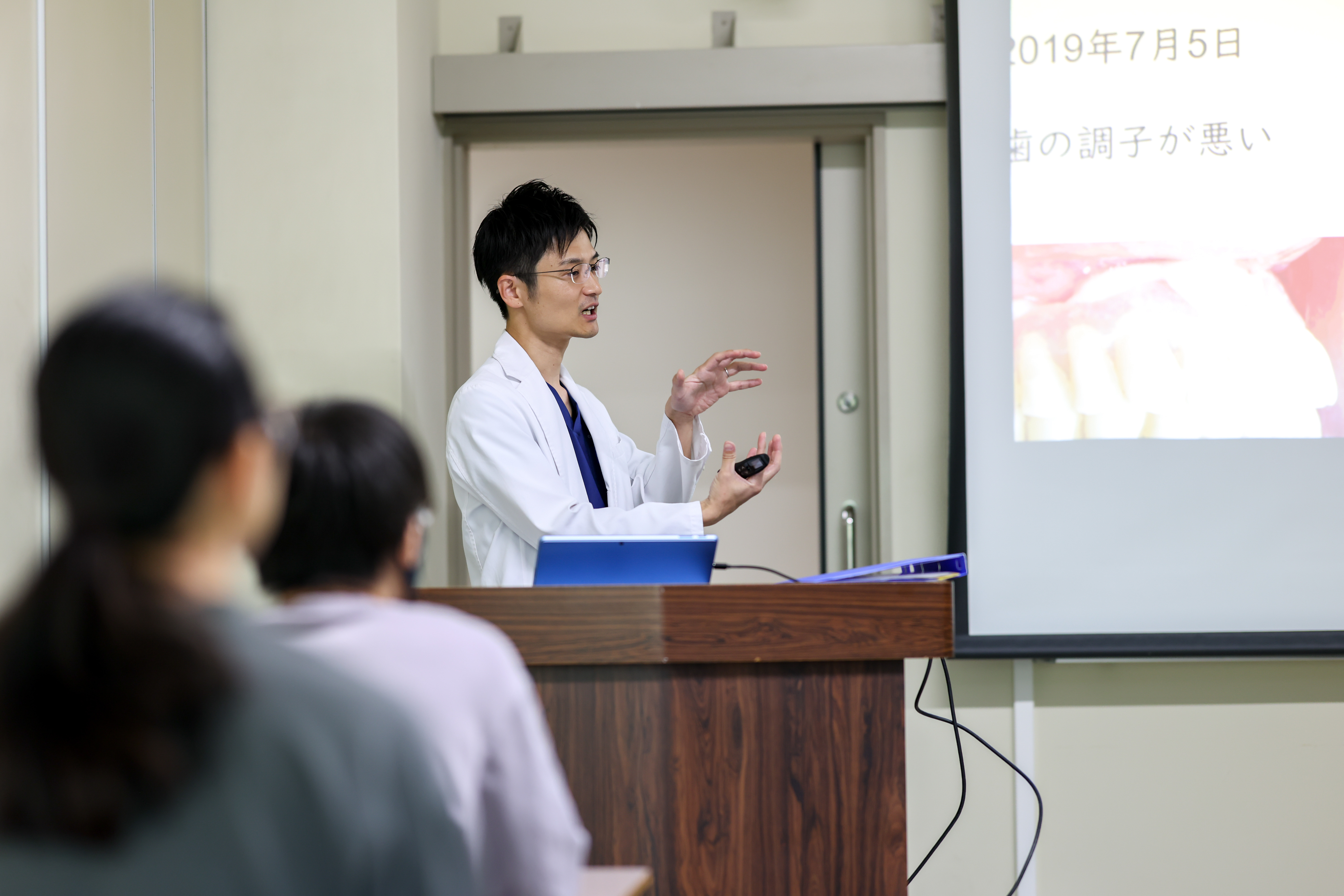
Clinical care, education, and research in one career
Dr. Mameno graduated from the University of Osaka School of Dentistry in 2014 and earned his doctorate there in 2019. After serving as an assistant professor and spending several months as a visiting researcher at the University of Adelaide, he became a lecturer at the University of Osaka Dental Hospital in July 2025.
Dentistry was familiar from childhood because one of his parents was a dentist. A news story about dental regenerative medicine then caught his imagination in high school. During fifth-year clinical training, he struggled to arrange the teeth for a complete denture, then watched the appliance become part of a patient’s daily life. “I felt that something I had made with my own hands was helping someone,” he recalls. “It was also the moment I discovered another kind of regeneration—the restoration of function.”
This idea of “restoring function” has become a thread running through his career. In the clinic, he helps patients regain oral function. In education, he trains future dentists to provide that care. And in research, he investigates how oral function may be connected to health beyond the mouth.
Connecting oral health with healthy longevity
The new study belongs to a wider research arc. Earlier OHSAKA analyses found that poor support from the back teeth was associated with a greater risk of losing additional teeth, while, among people who had lost that support, use of well-fitting dentures was associated with lower all-cause mortality than poorly fitting dentures or none [2][3]. The studies were observational, so they do not prove that a denture prolongs life. Their practical meaning is more immediate. “Back teeth are important not only for eating, but also for protecting the teeth that remain,” Dr. Mameno says.
Together, the findings trace a continuum, not three isolated statistics. Protect the teeth and biting support that remain. Restore function appropriately when teeth are lost. Continue professional assessment because important changes may be silent. This work on oral and systemic health in older adults was recognized with the University of Osaka Award in the Young Faculty category.
From awareness gaps to healthier years
From 2026 to 2028, Dr. Mameno is leading a project that will use longitudinal data from approximately 200,000 people to investigate how prosthodontic treatment may relate to healthy life expectancy. The World Health Organization’s Healthy Life Expectancy (HALE)—the number of years a person can expect to live in full health—offers an internationally recognized frame for why this question matters. The goal is not only a longer life, but more years lived in health.
The present study gives that next project a clear starting point. If many older adults do not notice bleeding gums or tooth mobility, awareness alone cannot serve as the safety net. By linking objective dental findings with outcomes over time, Dr. Mameno hopes to identify when examinations and prosthodontic care can make the greatest difference.
He believes that oral health is closely connected to healthy longevity across countries and cultures. By bringing together insights from daily clinical practice and evidence generated through large-scale population research, he hopes to advance evidence-based dentistry and contribute to a society in which more people can age in good health.
[1] Mameno, T., Otsuki, N., Takeuchi, S., Takeda, S., Iwayama, T., Takedachi, M., Yamamoto, R., Ikebe, K., Self-Reported Periodontal Symptoms and Clinical Periodontal Status in Older Adults With and Without Dementia: A Population-Based Diagnostic Accuracy Study. Journal of Clinical Periodontology 53, 1472–1480 (2026)
https://doi.org/10.1111/jcpe.70168
[2] Mameno, T., Otsuki, N., Wada, M., Yamamoto, R., Ikebe, K., Association between posterior occlusal support and tooth loss in a population-based cohort: The OHSAKA study. Journal of Dentistry 148, 105144 (2024)
https://doi.org/10.1016/j.jdent.2024.105144
[3] Mameno, T., Otsuki, N., Takeuchi, S., Takeda, S., Iwayama, T., Takedachi, M., Yamamoto, R., Ikebe, K., Removable denture use, fit, and all-cause mortality in older adults with reduced occlusal support: The OHSAKA study. The Journal of Prosthetic Dentistry 133, 1505-1511 (2024)
https://doi.org/10.1016/j.prosdent.2024.10.037
Further information: https://researchmap.jp/mameno?lang=en