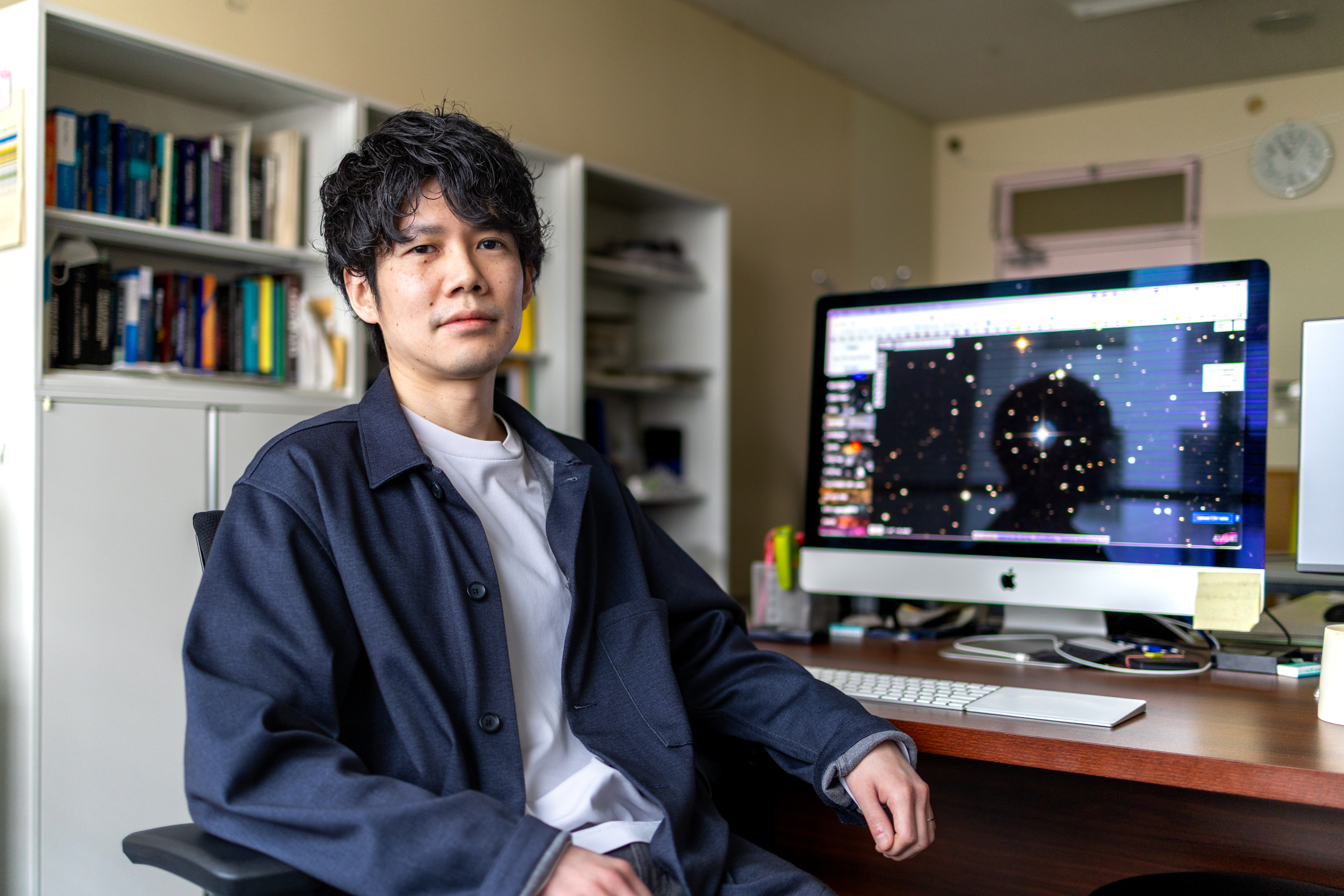
Dr. Kento Masuda, Graduate School of Science
Exploring the diversity of planetary systems
Planetary systems in our Galaxy are remarkably diverse. They contain planets with a wide range of sizes, compositions, and orbital configurations. Dr. Kento Masuda studies how this diversity arises by combining statistical studies of planet populations with detailed analyses of individual planetary systems.
His interest in astronomy was shaped in part by his experience in the International Physics Olympiad, where he became fascinated by how simple physical laws can explain phenomena on scales far beyond everyday experience. That perspective continues to guide his work today.
Young planetary systems as windows into the past
One of the central questions in exoplanet science is how planetary systems form and evolve into the wide variety we observe today. Because these processes unfold over immense timescales, astronomers cannot watch a single system change directly. Instead, they study planetary systems at different stages of their lives, with young systems offering especially valuable clues to the early history of planets.
Dr. Masuda focuses in particular on transiting multi-planet systems. When a planet passes in front of its host star, it causes a tiny dip in the observed starlight, known as a transit. In systems with multiple planets, their mutual gravity can also produce subtle shifts in the timing of those transits, known as transit timing variations, or TTVs. By analyzing these signals, astronomers can infer planetary sizes, masses, and orbital architectures, even in systems that are otherwise difficult to characterize.
Connecting unusual young planets to the bigger picture
Using these methods, Dr. Masuda has studied unusual young planetary systems with very low-density planets, including Kepler-51 and V1298 Tau. In earlier work on Kepler-51 , he used TTVs to show that its transiting planets are among the lowest-density planets known[1]. These highly inflated planets, often called “super-puffs,” provide important clues to how planets with extended gaseous envelopes form and evolve. Recent follow-up work on the Kepler-51 system has also refined our picture of this remarkable system by uncovering evidence for an additional, non-transiting planet, Kepler-51e [2].

More recently, in work published in Nature, Dr. Masuda used a multi-year TTV analysis of the young V1298 Tau system to show that its planets have low masses and large radii, making them much less dense than mature planets of comparable size[3]. Systems such as Kepler-51 and V1298 Tau therefore offer rare snapshots of planets at an early stage of evolution. In particular, V1298 Tau may represent a young progenitor of the small, close-in planetary systems that are common around older stars: over time, these young, puffy planets are expected to lose part of their atmospheres and shrink into the smaller planets that dominate the known exoplanet population today.
Together, these studies help reveal how young planets evolve into the diverse planetary systems observed throughout our Galaxy today.
[1] Masuda, K. Very Low-Density Planets around Kepler-51 Revealed with Transit Timing Variations and an Anomaly Similar to a Planet-Planet Eclipse Event. The Astrophysical Journal 783, 53 (2014).
[2] Masuda, K. et al. A Fourth Planet in the Kepler-51 System Revealed by Transit Timing Variations. The Astronomical Journal 168, 294 (2024).
[3] Livingston, J. H., Petigura, E. A., David, T. J., Masuda, K. et al. A young progenitor for the most common planetary systems in the Galaxy. Nature 649, 310–314 (2026).
Further information: https://researchmap.jp/kemasuda?lang=en