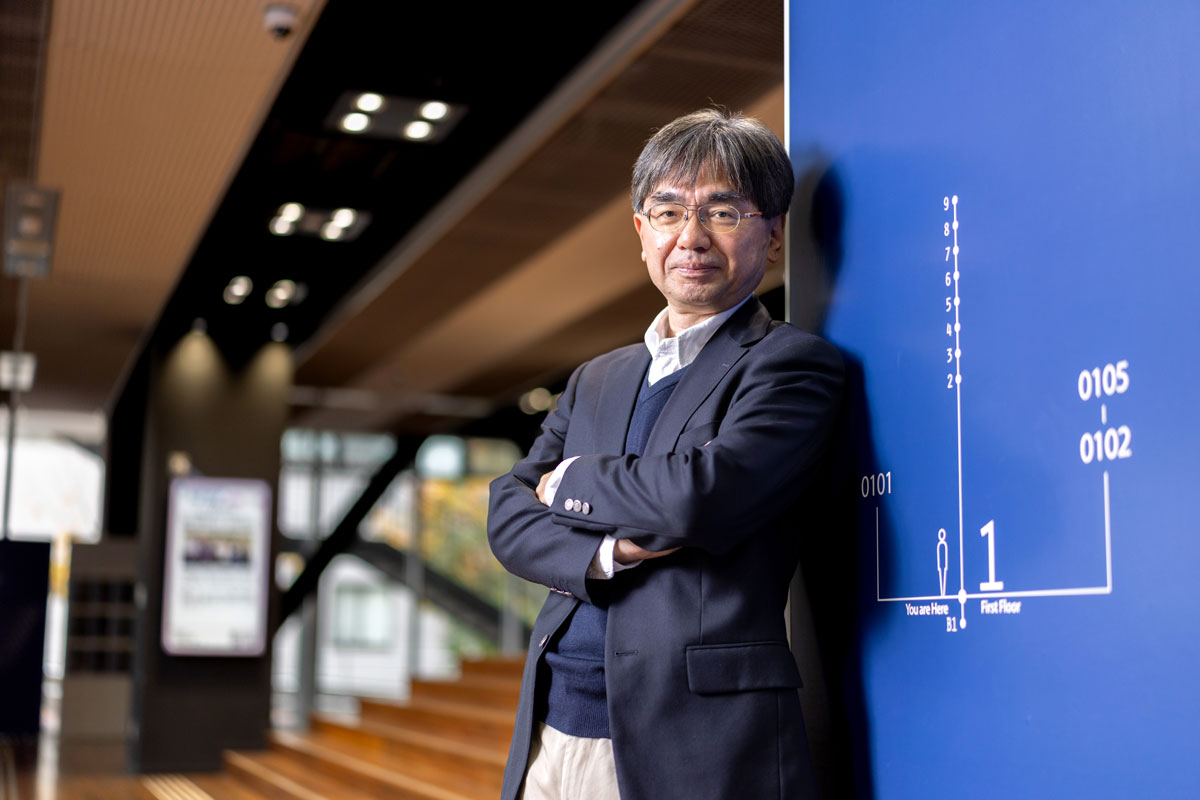
Specially Appointed Professor Naganari Ohkura, Graduate School of Medicine
"From Treg biology to clinical impact - Pioneering next-generation immunotherapy - "
Professor Naganari Ohkura has spent nearly two decades at the forefront of immunology, advancing the understanding of regulatory T cells (Tregs) and developing their therapeutic applications for cancer and autoimmune diseases. His scientific direction was profoundly shaped by his long-standing collaboration with Professor Shimon Sakaguchi, Distinguished Honorary Professor at the University of Osaka and the 2025 Nobel Laureate in Physiology or Medicine for the discovery of Tregs. Today, Professor Ohkura is working to translate this foundational discovery into next-generation cancer immunotherapy.
Invited into the world of Tregs
Professor Ohkura’s scientific path shifted dramatically in 2008, when he joined the Immunology Frontier Research Center (IFReC) at the University of Osaka. At the time, he had built his career at the National Cancer Center Research Institute, focusing on nuclear receptors that regulate gene expression. Meanwhile, Professor Sakaguchi’s group had identified the FOXP3 gene as an essential transcription factor for Treg development and was seeking collaborators with expertise in gene regulation.
Professor Ohkura recalls his introduction to the field with a laugh: “I had never met Professor Sakaguchi, and I didn’t even know what Tregs were. It truly felt like starting from zero.” Yet as he learned more, he became convinced that Tregs offered a research theme of exceptional potential. Their unique biology, remarkable functional significance, and the unwavering dedication of Professor Sakaguchi’s team inspired him to step into the field of immunology for the first time. He was also deeply motivated by Professor Sakaguchi’s perseverance in establishing the concept of Tregs, despite early skepticism within the immunology community.
Joining Professor Sakaguchi’s laboratory proved transformative. “Professor Sakaguchi is extremely rigorous,” he explains. “He never accepts half-done work. He expects everyone in his lab to produce papers that truly stand the test of time.” This uncompromising standard profoundly shaped Professor Ohkura’s approach as a researcher.
Toward Treg-targeting cancer therapies
In 2014, Professor Ohkura started his own lab at the Graduate School of Medicine. With the goal of "creating the next generation of cancer immunotherapy," he has been working in collaboration with a pharmaceutical company to develop an immunotherapy that targets Tregs to treat cancer, which could follow or surpass the impact of Opdivo, the anti-PD-1 antibody derived from Dr. Tasuku Honjo’s Nobel-winning discovery.
Tregs are present throughout the body and play a key role in immunosuppression. While they prevent harmful autoimmune reactions, they also suppress the immune system’s ability to attack cancer. Eliminating all Tregs could free T cells to destroy tumors, but it would simultaneously trigger dangerous autoimmune disease.
This led Professor Ohkura to propose a novel idea: selectively remove only the Tregs that suppress anti-tumor immunity, while preserving all other Tregs. His team searched for molecular markers distinguishing these tumor-associated Tregs. Their breakthrough came with the discovery that Tregs actively suppressing immune responses inside tumors express a unique surface molecule, CCR8.
In mouse models, antibodies targeting CCR8 successfully eliminated tumors without causing autoimmune disease. Clinical trials are now underway, with early results showing promise in colorectal cancer patients. “If this drug reaches the market, it will likely be the first Treg-targeted therapy in the world,” Professor Ohkura says. Having long built upon Professor Sakaguchi’s discovery, he feels a strong motivation to be the first to bring it into real-world clinical use. However, the competition is intense. Research groups around the world, including major pharmaceutical companies, are racing to develop Treg-targeted therapies. Yet Professor Ohkura remains grounded: “It’s only a matter of time before such drugs become available. Of course, I hope we achieve the first approval, but what matters most is that patients receive effective treatments.”
Realizing the full potential of Tregs
“The understanding of Tregs is our advantage,” Professor Ohkura says, emphasizing the unique position his team holds thanks to its foundational discoveries. His research focuses on unlocking the full therapeutic potential of Tregs, which could be used not only to treat cancer but also a wide range of autoimmune diseases.
Professor Ohkura is also developing a method to identify which patients are likely to respond to cancer immunotherapy, as current success rates of immunotherapy remain only 20–30%. By analyzing the immune microenvironment of tumors, his team aims to predict treatment efficacy before therapy begins. This approach is currently in preclinical testing in cancer patients.
For Professor Ohkura, these efforts represent the culmination of a long-held ambition. “Research is fascinating, but it often doesn’t lead directly to practical applications,” he explains. “I’ve always wanted to do something that could ultimately be given back to people. That opportunity is now right in front of me, and I’m willing to make it a reality.” With the development of a novel drug now within reach, Professor Ohkura is closer than ever to achieving that goal.
For further information: http://www.comit.med.osaka-u.ac.jp/en/project/projectA05.html