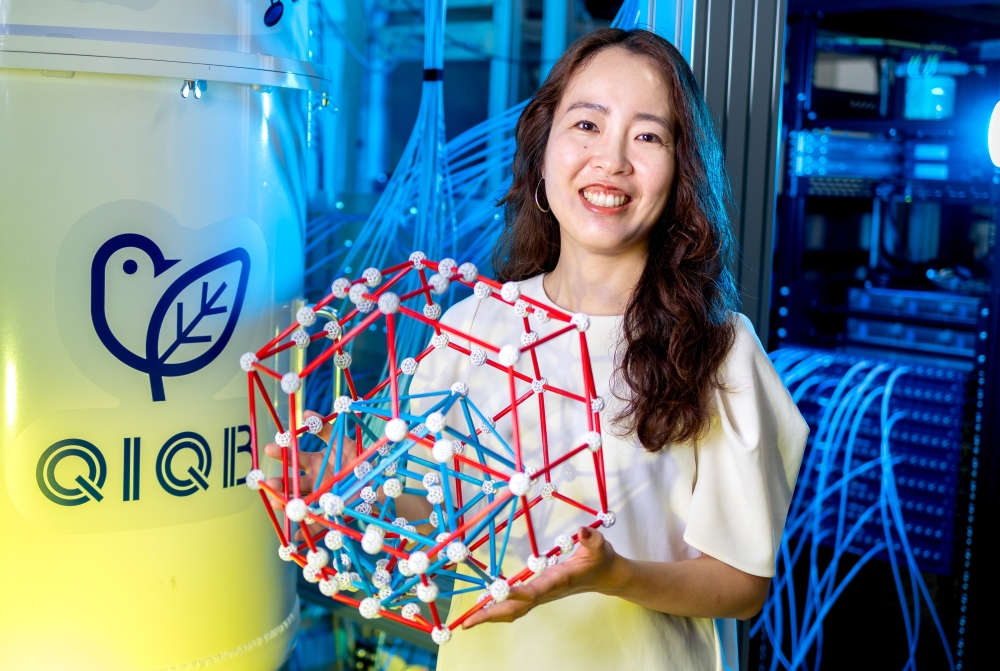
Dr. Nayuta Takemori, Associate Professor, Graduate School of Sciences
Exploring hidden order in quasicrystals and beyond
Solids are often introduced through a simple contrast. In periodic crystals, atoms are arranged in repeating patterns. In amorphous materials such as glass, there is no such long-range periodic order. Quasicrystals complicate this picture: they possess long-range order, but their structures do not repeat periodically.
Associate Professor Nayuta Takemori studies the physical phenomena that emerge when electrons interact in these unusual structures. Combining theoretical models, numerical simulations, and quantum algorithms, Dr. Takemori seeks the essential rules behind complex systems. This search now extends to hyperuniformity—a form of hidden order that may offer a broader way to understand different kinds of solids.
From visible matter to nonrepeating order
During undergraduate studies, Dr. Takemori was drawn to condensed matter physics because it deals with tangible materials—things that can be directly observed and handled. Although experimental work was not the right fit, numerical simulation offered another way to examine how physical properties emerge from mathematical models.
A turning point came during graduate school, when Dr. Takemori attended a seminar on a newly discovered strongly correlated quasicrystal. Dr. Takemori realized that a computational method normally used for periodic systems could be applied to these unusual structures—an area few researchers had explored at the time.
Quasicrystals can display fivefold or tenfold rotational symmetry, which ordinary periodic crystals cannot possess. Their structures and X-ray diffraction patterns are visually striking, with intricate geometric symmetry.
“More than anything, I was drawn to their beauty,” Dr. Takemori recalls.
After completing a doctorate, Dr. Takemori began studying superconductivity in quasiperiodic systems. Superconductivity is a state in which electrical resistance disappears. The question was not which material would become superconducting, but what form superconductivity might take without a repeating atomic structure.
In simulations first reported as a preprint in 2016 and published in 2017 [1], Dr. Takemori and collaborators found a superconducting phase whose Cooper pairs—the pairs of electrons responsible for superconductivity—behaved differently from those in conventional theory. Further calculations showed that the jump in specific heat at the transition could be smaller than the standard theoretical value, providing a possible measurable signature of superconductivity in a quasiperiodic structure.
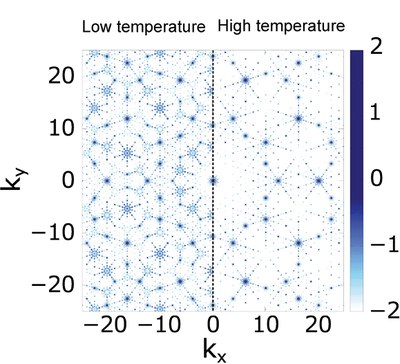
Although the underlying quasiperiodic structure remains unchanged, electronic correlations at low temperatures reorganize the electronic distribution, producing a more complex diffraction pattern. Adapted by Dr. Takemori from a figure in a previously published paper [2].
Connecting fields through quantum computing
“I enjoy doing something different from other people,” Dr. Takemori explains. “I also like bringing different fields together—noticing something in another field that could be useful for my own research, and combining the two.”
This continuing interest in interdisciplinary research has led Dr. Takemori to quantum computing. Calculations for quasicrystals can be difficult because their structures lack the repeating units that simplify conventional crystal models. Quantum computers may eventually help with parts of these calculations.
“I see quantum computing as a new tool for investigating the physical questions I have been studying,” Dr. Takemori notes.
Current quantum devices remain limited, but small test calculations can already be performed. Dr. Takemori’s group is developing algorithms for estimating reduced density matrices, or RDMs—compact mathematical descriptions of correlations among selected particles. The group has implemented an algorithm based on fermionic shadow tomography in a form that can run on quantum hardware.
Working directly with quantum-information and hardware researchers allows physical questions to guide the development of computational tools, while feedback from actual devices helps improve the algorithms.
Hyperuniformity and a wider ambition
Dr. Takemori is now deeply interested in hyperuniformity. In a hyperuniform structure, variations in density become strongly suppressed when the structure is viewed over large distances. Periodic crystals, quasicrystals, and some disordered materials can all be hyperuniform, despite their different appearances.
The visual appeal of these structures is part of their attraction, but Dr. Takemori also sees hyperuniformity as a possible common language for understanding solids. Extending the concept to local physical properties may help researchers tell apart effects that arise from geometry and those created by interactions among particles.
“I want to understand the rather disordered world through clear rules,” Dr. Takemori reflects.
Looking ahead, Dr. Takemori hopes to connect researchers from physics, chemistry, biology, engineering, and other fields through the study of hyperuniform structures. One aim is to move beyond understanding structures found in nature and explore artificial nanoscale structures whose optical or mechanical properties can be designed more directly. Possible applications include structures that control selected ranges of light, although these remain research goals rather than established technologies.
The broader ambition is to find a framework that can connect periodic crystals, quasicrystals, and unusually uniform amorphous materials. Hyperuniformity may provide that framework—or research may reveal that another principle is needed. Either outcome would deepen the understanding of how structure gives rise to physical properties.
Asked what research means, Dr. Takemori returns to the idea that has guided this journey.
“It is about extracting the essential elements that govern an apparently complex system and making the causal relationships clear,” Dr. Takemori concludes.
From the visible beauty of nonrepeating patterns to collaborations across disciplines, Dr. Takemori’s work seeks the order hidden within complexity.
[1] Sakai, S., Takemori, N., Koga, A. and Arita, R., Superconductivity on a quasiperiodic lattice: Extended-to-localized crossover of Cooper pairs. Physical Review B 95, 024509 (2017)
https://doi.org/10.1103/physrevb.95.024509
[2] Takemura, S., Takemori, N., and Koga, A., Valence fluctuations and electric reconstruction in the extended Anderson model on the two-dimensional Penrose lattice. Physical Review B 91, 165114 (2015)
https://doi.org/10.1103/PhysRevB.91.165114
Further information: https://researchmap.jp/takenayu?lang=en