
Professor Kaori Fukuzawa, Graduate School of Pharmaceutical Sciences
The power of AI and the wisdom of humanity: a new era of drug design
‘Drug discovery has truly entered a new era with generative AI,’ says Professor Kaori Fukuzawa, a pioneer leading in silico drug discovery research in Japan with quantum chemical calculations. The quantum chemical calculation is a theoretical approach based on the fundamental laws of physics and chemistry and is already a central pillar of modern drug discovery, enabling researchers to understand how potential drug molecules interact with disease-related proteins.
The frontiers of life through quantum chemistry with AI
The rapid and remarkable advancement in AI has significantly accelerated Professor Fukuzawa’s research over the past year. ‘Generative AI has had two major impacts on our research,’ Professor Fukuzawa explains. ‘One is protein structure prediction recognized with the 2024 Nobel Prize in Chemistry. The other is the ability to design entirely new drug candidate molecules.’ Instead of researchers manually considering possible combinations of compounds, AI can now generate suggestions based on our scientific knowledge. This shift has enabled entirely new ideas and combinations, leading to explosive progress in our research.
Drug discovery begins by identifying molecules that interact with target proteins in the body. Traditionally, researchers screen millions of compounds stored in large databases called compound libraries, gradually narrowing down promising candidates through computational analysis such as molecular docking and quantum chemical calculations. With generative AI, however, researchers can create tens or even hundreds of thousands of new molecules from just a few initial candidates. By combining AI with advanced computational chemistry, drug discovery has become dramatically more efficient, not only in speed and accuracy, but also in creativity. ‘Generative AI is perfectly suited for discovering completely new medicines,’ Professor Fukuzawa says.
The Graduate School of Pharmaceutical Sciences is now operating an automated compound synthesis robot. Once researchers program the compounds proposed by AI, the robot can synthesize them overnight. This is truly the advancement of technology.
Leading industry-academia collaboration with cutting-edge method
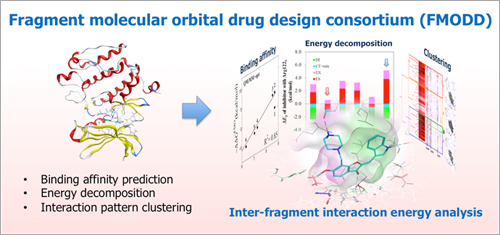
Professor Fukuzawa uses the Fragment Molecular Orbital (FMO) method, a cutting-edge computational technique originally proposed in Japan in 1999. The FMO method divides large molecules such as proteins into smaller fragments, performs quantum chemical calculations on each fragment, and then reconstructs the entire system to reveal detailed interactions between proteins and drug candidates.
She was among the first researchers in the world to apply the FMO method to drug discovery calculations in 2000. In 2014, she launched the FMO Drug Design Consortium, bringing together academia and industry to advance computational drug design. Today, the consortium has released tens of thousands of FMO calculation results, providing valuable data for the scientific community. These studies rely on Japan’s advanced computing infrastructure, including supercomputers such as Fugaku and the nationwide HPCI network, which connects high-performance computing systems across research institutions. Professor Fukuzawa’s projects have received awards three times in the past decade for utilizing the HPCI.
The University of Osaka - a hub for in silico drug discovery
According to Professor Fukuzawa, The University offers an ideal environment for computational drug discovery research. One key resource is the SQUID supercomputer at the university’s D3 Center. In fact, for quantum chemical calculations, SQUID can outperform Fugaku in certain aspects. Using the SQUID supercomputer, the team succeeded last year in analyzing all of the roughly 6,000 basic protein structures among the approximately 220,000 biomolecular structures known at the time [1]. The database has since expanded to about 250,000 structures, and our calculation results for roughly one-fifth of them (32,000) have now been made publicly available.
Another major strength is the Institute for Protein Research, which hosts PDBj, the Asian hub of the worldwide Protein Data Bank. PDBj develops advanced analytical technologies that link protein structural data with FMO computational research. In addition, the Graduate School of Pharmaceutical Sciences is equipped with experimental facilities including the new automated compound synthesis robot that help translate computational discoveries into real drug development. The University of Osaka offers dynamic environment with advanced computation, AI and experimental science, opening the door to the next generation of scientific discovery.
‘But above all,’ Professor Fukuzawa emphasizes, ‘our greatest resource is our students. They are highly motivated, and their potential is limitless.’
Quantum chemistry - answering the “why” of life
Generative AI represents the cutting edge of in silico drug discovery. By learning from existing data, AI can propose increasingly accurate candidate molecules, greatly expanding the possibilities of chemical libraries. ‘AI gives us many new ideas for drug discovery,’ Professor Fukuzawa explains. ‘But these are only the seeds of ideas. It is still human researchers who nurture those seeds and turn them into discoveries. That is where the real excitement of research lies.’
Interestingly, Professor Fukuzawa’s own research journey began with interstellar molecules drifting through space. As a student, she studied chemical reactions of simple molecules involving just three or four atoms using quantum chemistry. ‘Experiments sometimes show phenomena that are difficult to explain. But theoretical chemistry allows us to build logical explanations step by step. That was fascinating to me.’
Today, her research focuses on proteins containing thousands or even tens of thousands of atoms. Yet the underlying principles remain the same. ‘The same quantum chemistry connects everything from the universe to drug discovery. That’s what makes it so exciting.’
Her group is now expanding FMO research to include dynamic analyses that account for fluctuations in protein structures in the biological environment. They are also studying interleukins, key molecules involved in immune cell signaling, to identify recognition mechanisms that could enable small-molecule drug development. ‘Small-molecule drugs can be made into tablets, are stable at room temperature, and are relatively inexpensive,’ she explains. ‘In drug discovery, replacing large biomolecules with smaller molecules has always been an important goal.’
[1] Takaya, D., Ohno, S., Miyagishi, T. et al. Quantum chemical calculation dataset for representative protein folds by the fragment molecular orbital method. Sci Data 11, 1164 (2024). https://doi.org/10.1038/s41597-024-03999-2