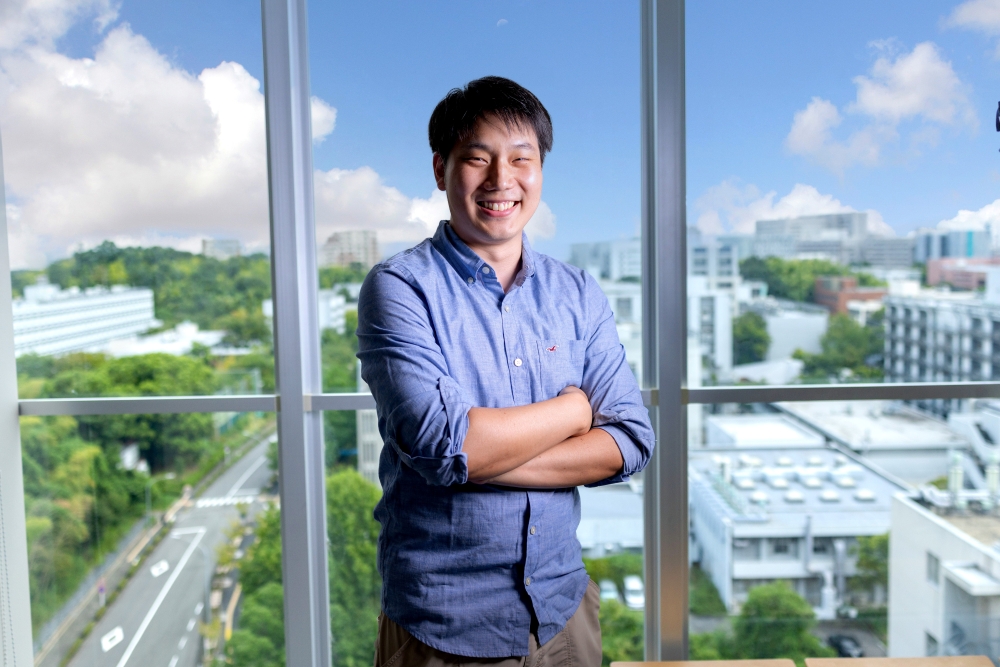
Dr. Kelvin Y. Chen, Associate Professor, Immunology Frontier Research Center (IFReC)
Reading cells under perturbation: uncovering the rules of immune identity and function
“We now know what kinds of cells exist, but we don’t know why they exist—how they are specialized or maintained.”
An immune detour: from cancer biology to regulatory T cells
Dr. Kelvin Y. Chen did not originally set out to become an immunologist. As an undergraduate at the University of Osaka (UOsaka), he was drawn to cancer biology. Yet while studying tumor biology, he became interested in the immune system’s role in tumor development and anti-tumor responses. This led him to regulatory T cells, or Tregs—specialized cells that restrain immune responses and can also be recruited by tumors to weaken anti-tumor immunity.
Dr. Chen entered the School of Science at UOsaka as a member of the first cohort of the Chemistry-Biology Combined Major Program (CBCMP), an undergraduate degree program taught in English. After completing his bachelor's degree, he joined Professor Shimon Sakaguchi’s laboratory, where he went on to complete his master’s and doctoral degrees. His interest in Tregs became part of a broader question: if nearly every cell in the body contains the same DNA, what makes each cell type so different? That question stayed with him, and in April 2026 he took up his appointment as one of two Young Lead Researchers (YLR) at IFReC — selected through a competitive, worldwide search as part of the program's five-year track for early-career researchers building independent, internationally competitive laboratories—to pursue it in a laboratory of his own.
Functional immunogenomics: reading cells under perturbation
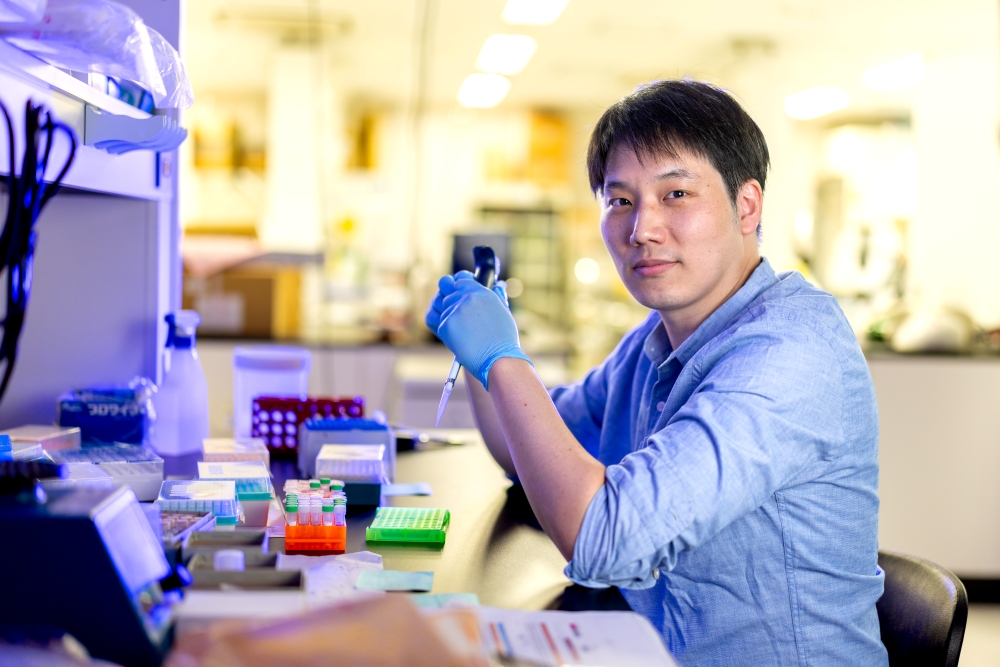
This question anchors Dr. Chen’s Functional Immunogenomics laboratory [1]. The group develops and applies cutting-edge approaches to study how specific gene-regulatory programs control immune cell fate and function. Single-cell methods can catalog cell types in remarkable detail, but Dr. Chen is interested in going a step further: understanding the mechanisms that give cells their identities and function. To do this, he perturbs cells—with CRISPR editing, chemicals or disease-related conditions—and measures their response. “Functional,” in other words, means learning how a biological system works by challenging it and observing what changes.
The approach changes both the speed and scale of research. A conventional knockout-mouse project could take a year to create one model and several more years to analyze it. With CRISPR, hundreds of gene knockouts can be generated in cells in far less time, including cell types that were previously difficult to manipulate, such as human immune cells. Single-cell and multi-omics profiling can then read the effects of many perturbations in parallel. “The bottleneck is no longer producing data,” Dr. Chen says, “but deciding what the data mean.”
An unexpected regulator: RBPJ and FOXP3
That unbiased strategy powered Dr. Chen’s 2025 Nature paper, “Genome-wide CRISPR screen in human T cells reveals regulators of FOXP3” [2]. FOXP3 is the master transcription factor of Tregs, helping define their identity and suppressive function. The team screened primary human T cells and identified the RBPJ–NCOR complex as a context-specific repressor of FOXP3. This was surprising because RBPJ is best known for canonical Notch signaling, yet its effect on FOXP3 was independent of that pathway.
Removing RBPJ increased FOXP3 expression and improved the differentiation, stability and suppressive function of induced Tregs. In a humanized mouse model, the edited cells more effectively suppressed graft-versus-host disease. The findings point toward better Treg-based therapies for autoimmune disease, but Dr. Chen is cautious: “Honestly, it is very hard.” First he wants to understand what makes a Treg a Treg; reliable therapies must grow from that foundation.
Future vision: AI and cultivating independence
Looking ahead, Dr. Chen is interested in using AI to navigate vast single-cell and multi-omics datasets. He does not see AI replacing scientists. Instead, it could rank hundreds of perturbations, flag unexpected results and help prioritize and decide what deserves deeper investigation. In other words, AI may help direct researchers’ attention, but scientists still need to explain the biology.
As he builds his own group, Dr. Chen wants growth to be deliberate: students and postdoctoral researchers should develop their own questions instead of simply receiving assignments. His advice to young and international researchers is direct: "Choose a mentor and environment aligned with your interests. A PhD is long and demanding; curiosity, happiness and independence help make it sustainable."
Finally, Dr. Chen credits his scientific growth to the independence Professor Sakaguchi allowed him and to IFReC’s international, interdisciplinary environment. At IFReC, he has access to major research facilities and collaborations that connect specialists across fields and countries. He also values Osaka ’s friendliness—especially people’s willingness to talk when he first arrived and could not yet speak Japanese.
[1] Functional Immunogenomics Laboratory, IFReC
https://www.ifrec.osaka-u.ac.jp/en/laboratory/kelvin_chen/index.htm
[2] Chen, K. Y., et al., Genome-wide CRISPR screen in human T cells reveals regulators of FOXP3. Nature 642, 191–200 (2025)
https://doi.org/10.1038/s41586-025-08795-5
Further information: https://researchmap.jp/chenk_4463?lang=en