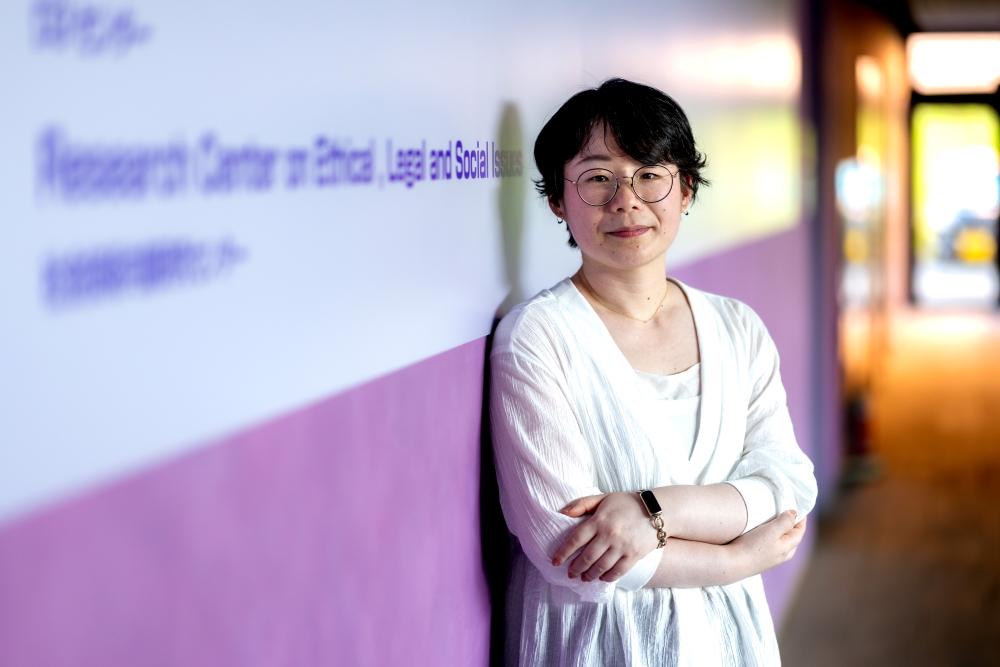
Assoc. Professor Fumiko Kudo, J.D., Specially Appointed Associate Professor, Research Center on Ethical, Legal and Social Issues (ELSI)
Why unease matters in governing AI
Working at the intersection of information law, public policy and AI governance, Assoc. Professor Fumiko Kudo, J.D., studies how principles are translated into the rules, practices and decisions that shape technology in society. Her projects range from international AI transparency frameworks to corporate case studies and experiential learning.
At the heart of her work is a deceptively simple question: when technology changes what people and institutions can do, how should society decide what ought to be done?
Starting with what feels uncomfortable
When Assoc. Professor Kudo tells people that she studies AI, law and society, they sometimes assume that she must be an enthusiastic supporter of the technology. “I cannot say that I like AI. If anything, I lean the other way,” she says with a laugh.
That unease is not resistance for its own sake. AI has been embraced at remarkable speed by individuals, companies and governments, even as it raises questions about discrimination, privacy, misinformation and inequality. she wants to understand that gap: why a technology that makes many people uneasy is also so readily welcomed. For her, discomfort is a productive starting point. It directs attention beyond technical performance to the power, rules and human decisions that determine how technology affects society.
Making AI governance visible
In April 2023, ahead of the G7 Digital and Tech Ministers’ Meeting, Assoc. Professor Kudo, then serving at the World Economic Forum Centre for the Fourth Industrial Revolution Japan (WEF), helped coordinate the Digital Transformation Summit, an official public-private event co-hosted by the WEF and Japan’s Ministry of Economy, Trade and Industry. Bringing public- and private-sector leaders into the same conversation showed how international principles depend on practical mechanisms that organizations can use.
That challenge is central to the Hiroshima AI Process (HAIP) Reporting Framework, launched in February 2025. The voluntary framework enables organizations to disclose how they are putting the Hiroshima Process International Code of Conduct for Organizations Developing Advanced AI Systems into practice. It is now moving into a new phase: more than 50 organizations have already pledged to complete a HAIP report using the new framework.
Assoc. Professor Kudo and her colleagues have interviewed participating organizations to examine how voluntary disclosure works in practice. Flexibility can lower the barrier to participation, but companies also need a shared vocabulary, concrete examples and opportunities to learn from one another. Her team has supported that process through a Japanese-language handbook and hands-on sessions. For her, reporting is not simply administrative work. It makes governance visible: what risks an organization recognizes, what it is doing about them and what it is prepared to explain to society.

Learning governance through conflict
Rules and reports are not the only ways to make governance tangible. Together with Dr. Arisa Ema of the University of Tokyo, Assoc. Professor Kudo developed the negotiation-based simulation game Egao no Shazai Kaiken—literally, “A Smiling Apology Press Conference.” Participants enter a fictional crisis in which an AI-powered job-hunting service is accused on social media of using a gender-discriminatory algorithm. Taking the roles of the service provider and the AI developer, they must negotiate responsibility, disclosure and how to face a press conference later that day.
The exercise is deliberately uncomfortable. Conventional lectures can leave governance as a set of abstract terms; the simulation forces participants to make choices when interests conflict and no perfect answer is available. The memory of that difficult experience becomes the lesson.
The same focus on real decisions appears in the ELSI Center’s collaboration with Mercari. In 2023, the company disclosed an unexplained gender pay gap of about seven percent after accounting for factors such as job type and grade. Mercari’s analysis suggested that part of the gap could be attributed to differences carried into salary offers from employees’ previous jobs, particularly in mid-career hiring, and the company then made compensation adjustments that reduced the figure to 2.5 percent as of 2023. Assoc. Professor Kudo and her colleagues then convened outside experts to review the analysis and turn the case into a resource for other organizations. Building on an example of how data-driven insights can guide management decisions, the case points to a broader possibility. Even for sensitive information such as HR data that is difficult to disclose directly, having external experts validate the analytical methodology and determine an appropriate scope for disclosure can deepen a sense of fairness among employees and society at large, easing the discomfort that might otherwise linger.
A brake, an accelerator—and a question for science
Assoc. Professor Kudo’s approach is shaped by her background in law. Postwar constitutional law has asked how power should be restrained to protect individual rights; it must also consider how legitimate power should be exercised to protect vulnerable people. She describes governance as requiring both a brake and an accelerator. The aim is neither to stop technological development nor to let innovation proceed without scrutiny, but to constrain harmful uses while enabling beneficial ones.
This balance also exposes a productive tension between engineering and law. Engineering often approaches emerging technologies through risk management before harm occurs. Law draws on both regulation before harm and remedies afterward. She asks whether frameworks developed for product safety or finance can fully capture concerns central to law: not only rights such as privacy and discrimination, but also questions of justification, meaning why a given restriction or intervention is warranted, and legitimacy, meaning whether the authority exercising it is properly constituted and accountable. Connecting these traditions is essential if governance is to be both workable and humane.
She is now extending the same perspective to AI’s impact on science. Much of the AI for Science movement asks what discoveries AI can accelerate. She asks a more fundamental question: what is science for? Across her work, the common thread is a refusal to treat technological change as self-explanatory. By making governance visible, conflict experienceable and hidden assumptions discussable, she creates room for society to choose the relationship it wants with technology. In an age captivated by speed, her willingness to remain with unease may itself be a powerful form of progress.
For further information: https://researchmap.jp/fumikok?lang=en