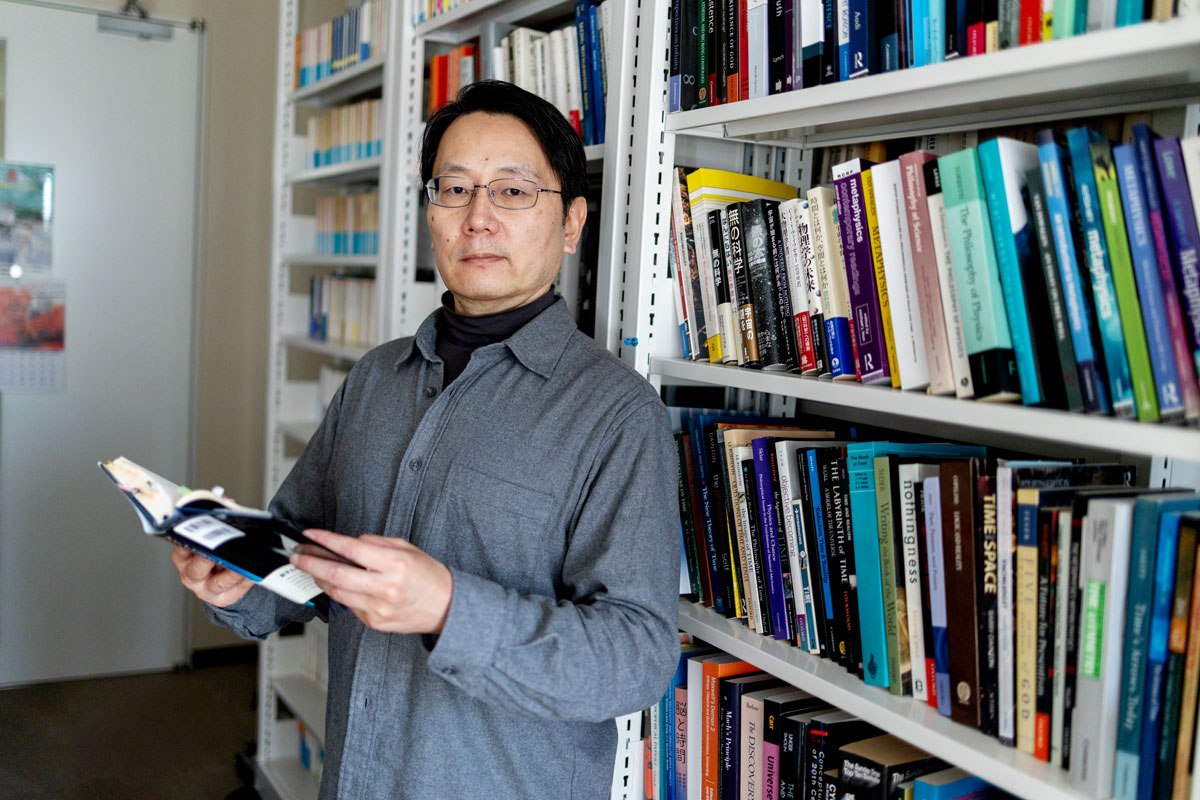
Professor Kunihisa Morita, Graduate School of Human Sciences
"Challenging common sense through philosophy"
Professor Kunihisa Morita, a scholar of philosophy of science and analytic philosophy, is a “double doctorate,” holding PhDs in both science and literature. Originally a researcher in high-temperature superconductivity, he was drawn to the philosophical implications of quantum mechanics and relativity, which led him toward the philosophical questions that had long interested him. His work probes the foundations of science, the nature of time, and the emerging challenges posed by generative AI, consistently overturning familiar assumptions.
Reconsidering What Science Really Is
The central themes of the philosophy of science can be broadly divided into two areas. One concerns science itself: “What is science?” and “How is scientific knowledge justified?” The other examines the worldviews implied by specific sciences, such as quantum mechanics. In his book Philosophy of Science: A Lecture (2012), he reinvestigates the unquestioned belief in scientific certainty. He highlights the inherent fragility of inductive reasoning, which underpins our derivation of natural laws, and even challenges Karl Popper’s influential criterion of falsifiability.
"For instance, if Galileo's heliocentric theory were correct, the annual parallax of stars should have been observable," Professor Morita explains. "But with the best technology of the time, it wasn't. If Galileo and his contemporaries had abandoned the theory simply because it was 'falsified' by the available evidence, the subsequent development of science would have been halted." This historical example illustrates his quest for a more nuanced standard for what constitutes scientific progress, arguing that theories often need to be protected from premature refutation to flourish.
Beyond Knowledge: Knowing vs. Understanding
Professor Morita’s recent work focuses on the nature of scientific understanding, which scholars increasingly view, not mere explanation, as a primal aim of science. He argues that understanding is epistemically deeper than simply “knowing,” and this has brought the epistemology of understanding to the forefront as a higher form of epistemological achievement."
To illustrate the difference, he offers the example of an ammonia molecule. "You may know that an ammonia molecule has a trigonal pyramidal structure and is polar because of its asymmetrical charge distribution," he says. "But without genuine understanding, you wouldn't be able to answer a counterfactual question like, 'What if it were a flat triangular molecule?' The correct answer is that the polarities would cancel, making it nonpolar."
While virtue epistemologists claim that answering such questions is inherent in the act of "knowing," Professor Morita proposes a different view. In a forthcoming journal article [1], he argues that understanding is the acquisition of the ability to answer these counterfactuals, whereas knowing is the application of that ability. In his view, "understanding precedes knowing." This distinction has profound implications, especially as he applies it to one of today's most pressing questions: "Does AI truly understand?"
A Four-Dimensional World: The Philosophy of Time
Professor Morita also refers to his longstanding research into the philosophy of time, a mystery deepened by 20th-century physics. He argues that while time may be part of spacetime, it does not literally “flow.” “Zeno’s famous paradox claims that Achilles can never catch a tortoise, which would mean motion is the impossible,” he explains. “But motion undeniably exists. So the way I see it, the only consistent resolution is to think of motion as an infinite process that is already completed, one that does not require time to flow at all.”
Insights from relativity, in which time is fused with space and varies with the observer, support a four-dimensional picture. Professor Morita likens existence to a cookie-cutter: each spatial slice is a cross-section of a longer, extended being that stretches through time. Past, present, and future are all parts of this temporal “stick.” From this view, Zeno’s paradox dissolves naturally. Even if counter-intuitive, a non-flowing conception of time may better explain the structure of reality.
Will AI Become a Philosopher?

Professor Morita is also deeply engaged with the philosophical implications of artificial intelligence. He notes a recent report in which an AI, given only observational data of Mars from Earth and no prior training, independently produced a heliocentric model. If AI could similarly “rediscover” relativity or quantum mechanics, it would challenge sociological theories claiming that scientific development depends heavily on historical and social conditions.
The progress of AI has been extraordinary, with systems steadily accomplishing tasks once thought impossible. Even without introspection, AI now responds naturally to jokes and can handle sophisticated counterfactual questions, such as those involving the ammonia molecule. As a result, the once-clear boundary between human and machine cognition is growing increasingly blurred. He examines this provocative issue in greater depth in his forthcoming book [2].
[1] Kunihisa Morita, 'Irreducibility of Understanding-Why to Knowledge of Cause: Unravelling the Confusion', Disputatio (forthcoming)
[2] Philosophy of Science for Scientists [in Japanese] (2025) Kyoto: Kagaku-Dojin
For further information: https://researchmap.jp/kunihisa_morita?lang=en