- Pre-book only
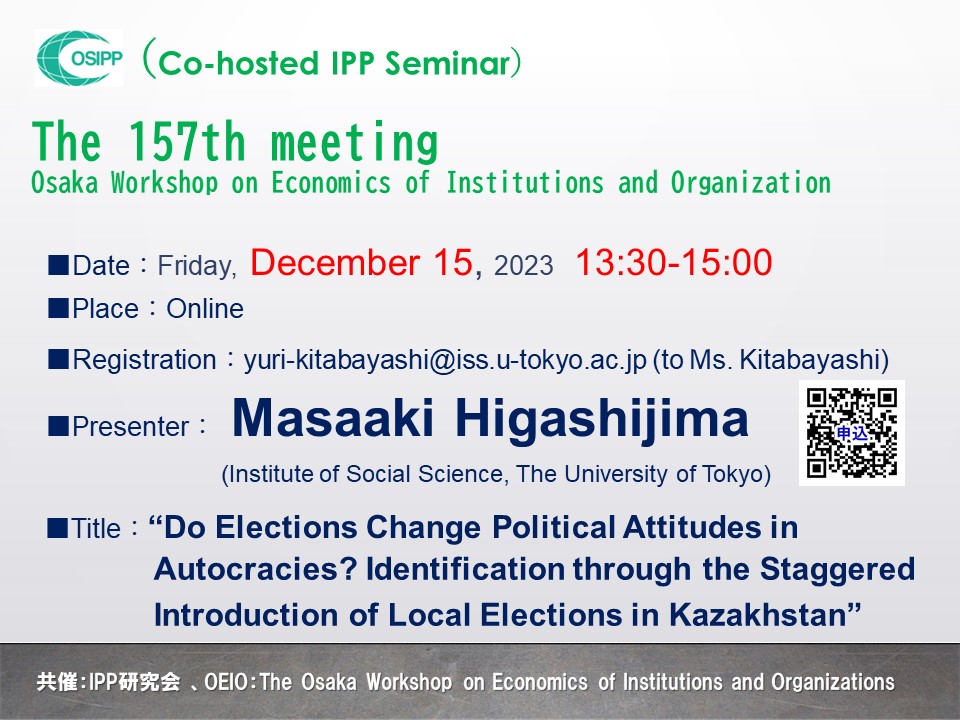
The 157th meeting jointly organized with International Public Policy Seminar
Intended for |
|
|---|---|
Date | 2023.12.15 Fri 13:30 - 15:00 |
Venue |
|
Contact | KITABAYASHI, Institute of Social Science, The University of Tokyo |
The Osaka Workshop on Economics of Institutions and Organizations, OEIO, meets every month to exchange research ideas on institutional and organizational economics. Participants include both people specialized in theoretical research and those in empirical research. Topics of meetings might be about microeconomic theory, macroeconomic theory, or economic history..., whatever on institutional and organizational economics.
Presenter: Masaaki Higashijima (Institute of Social Science, The University of Tokyo)
Title: “Do Elections Change Political Attitudes in Autocracies? Identification through the Staggered Introduction of Local Elections in Kazakhstan”
Abstract: Scholars have studied authoritarian elections primarily from the dictators' perspective: Competitive elections help autocrats to improve governance by grasping grass-roots popular preferences. However, how competitive elections alter the public's views on the regime is underexplored, despite the fact that popular perceptions serve as micro foundations of such information mechanisms. To fill this gap, we conduct a survey in Kazakhstan to examine the impact of local elections on citizens' attitudes toward local elites and politics. We exploit the staggered introduction of local multi-candidate elections due to past turnovers of appointed village chiefs for causal identification, utilizing the item count technique, conjoint analysis, and anchoring vignettes for measuring political attitudes accurately in autocratic contexts. We find that those who have experienced their first-ever election express higher levels of political efficacy but report more frequent experiences of bribing local officials. Also, our conjoint experiment suggests that people do neither punish or reward their village leaders' policy responsiveness even after experiencing the first multi-candidate election. The overall results indicate that local multi-candidate elections in autocracies may make citizens think that their voice is heard but do not necessarily change popular evaluations of their leaders and even induce negative sentiments toward the quality of government.