- Pre-book only
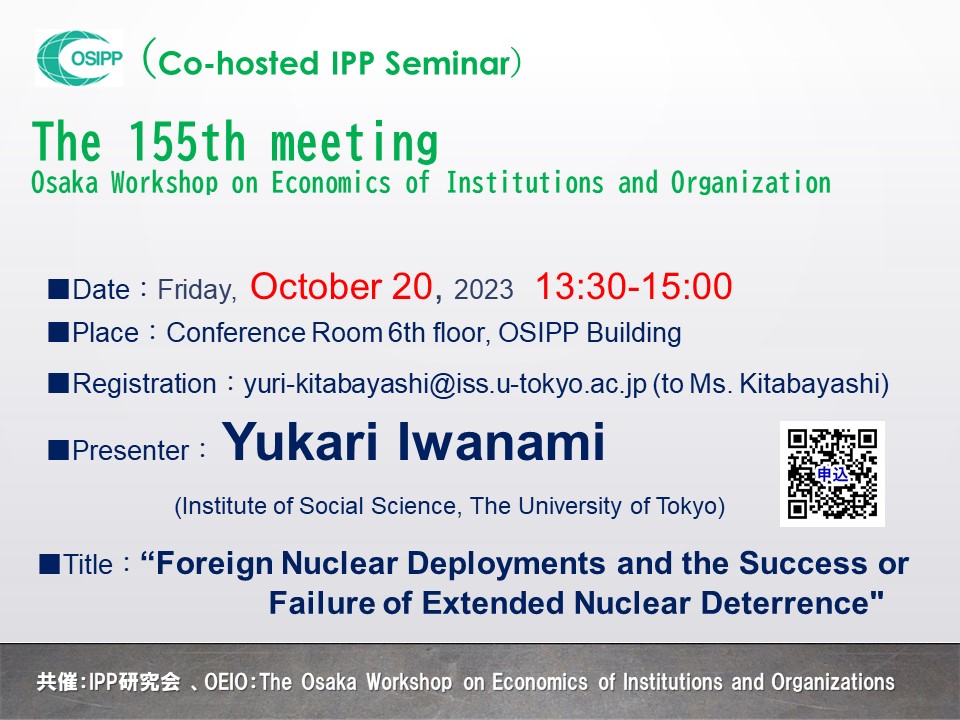
The 155th meeting jointly organized with International Public Policy Seminar
Intended for |
|
|---|---|
Date | 2023.10.20 Fri 13:30 - 15:00 |
Venue |
|
How to apply | Send an email to Ms. Kitabayashi via the address listed in the Contact section below. |
Contact | Ms. Kitabayashi, Institute of Social Science, The University of Tokyo |
The Osaka Workshop on Economics of Institutions and Organizations, OEIO, meets every month to exchange research ideas on institutional and organizational economics. Participants include both people specialized in theoretical research and those in empirical research. Topics of meetings might be about microeconomic theory, macroeconomic theory, or economic history..., whatever on institutional and organizational economics.
Presenter: Yukari Iwanami (Institute of Social Science, The University of Tokyo)
Title: "Foreign Nuclear Deployments and the Success or Failure of Extended Nuclear Deterrence"
Abstract: The success of extended nuclear deterrence is often believed to hinge on the credibility of the nuclear patron’s retaliatory threats, and some protégés agree to host the patron’s nuclear weapons on their territory in the hope that their presence would enhance extended deterrence. However, few theoretical studies provide a mechanism of how foreign-deployed nuclear weapons would enhance the credibility of retaliation and dissuade a potential aggressor from attacking the host state. Using a game-theoretic model, I demonstrate that the possibility that a nuclear war is contained within the host state’s region (i.e., decoupling) will reduce the likelihood that the patron state would abandon the host state in an event of a nuclear attack. Yet the same possibility might increase the host state’s fear that the patron state is emboldened to escalate the level of violence, dragging the host state into an unwanted nuclear war. If the potential aggressor believes that the host state makes concessions so as not to be entrapped into a nuclear war the patron initiates, deterrence may fail even though the patron has the willingness to bear the cost of a regional nuclear war. Accordingly, the credibility of the patron’s retaliatory threats does not suffice to ensure the success of extended deterrence: the host state’s resolve as well as the patron’s reassurance are required.