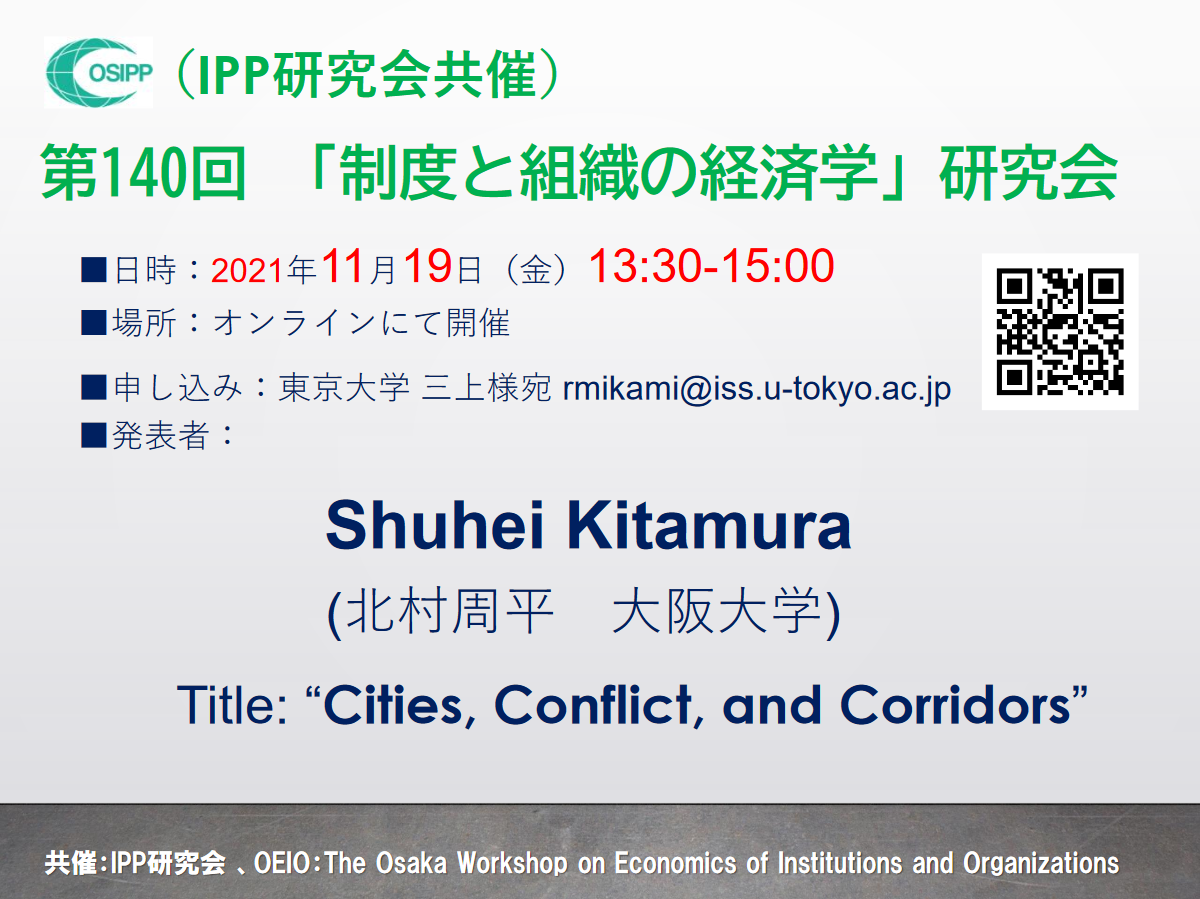
The 140th meeting jointly organized with International Public Policy Seminar
Intended for |
|
|---|---|
Date | 2021.11.19 Fri 13:30 - 15:00 |
How to apply | Send an email to: rmikami@iss.u-tokyo.ac.jp (MIKAMI, Institute of Social Science, The University of Tokyo) |
Contact | MIKAMI, Institute of Social Science, The University of Tokyo 03-5841-4936 |
The Osaka Workshop on Economics of Institutions and Organizations, OEIO, meets every month to exchange research ideas on institutional and organizational economics. Participants include both people specialized in theoretical research and those in empirical research. Topics of meetings might be about microeconomic theory, macroeconomic theory, or economic history..., whatever on institutional and organizational economics.
Date: Friday, November 19, 2021 13:30 to 15:00
Format: Online
Application: (mail to) rmikami@iss.u-tokyo.ac.jp
Presenter: Shuhei Kitamura, Center for Infectious Disease Education and Research, Osaka University
Title: "Cities, Conflict, and Corridors"
Abstract: In this paper we propose that state structure in European history is linked to how geography affects the effective distance between state capitals. First we document that military battles tend to occur close to the shortest-distance corridors between the capitals of the belligerent powers, *except* where that corridor is intercepted by certain types of geography, specifically seas, mountains, and marshes. Geography thus seems to have influenced the effective military distance between the belligerents' capitals. Then we explore similar corridors between a multitude of European cities, documenting two patterns: (1) state capitals tend to be closer to each other when the geography between them is more separating, as measured by similar types of geography found to affect battle locations; (2) controlling for distance, the likelihood that any two cities are located in the same state decreases with the same types of geography between them. We present a model consistent with these patterns.